
TL;DR - WTF is $REKT?
$REKT is the first brand coin, a token that captures belief in a brand before it becomes mainstream. It rewards early supporters not through utility or entitlement, but through alignment, participation, and cultural relevance.
Created from the cult NFT project Rektguy, $REKT is not a security, has no utility, and carries no rights to equity or revenue. It is a memetic, liquid, tradable expression of brand sentiment.
Key facts:
- Total supply: 420,690,000,000,000 (fixed)
- Community allocation: 63.5%, with 38.5% reserved for future rewards
- Launched on: Ethereum, with cross-chain access via LayerZero
- Real-world traction: Over 680,000 Rekt Drinks sold in 32 countries
- Equity distributed: 5% of Rekt Brands Inc. successfully claimed by NFT holders under Reg CF
- Trading venues: Available on DEXs and CEXs (see CoinGecko for the full list)
$REKT is not an equity token. It is a new digital primitive, turning brand equity into something liquid, visible, and community-owned.
1. The Problem
1.1 Introduction
Rekt Coin ($REKT) is the first ever brand coin. While there are, and will be, other tokens that naturally fall into this category, $REKT is the first to explicitly claim this identity, which sits within the meme coin sector. $REKT is not just a cultural asset. It represents belief in a brand and a movement before they hit the mainstream. It rewards loyalty and early support and signals the beginning of a new era in social money where brand equity is liquid, tradeable, and owned by the community.
1.2 Early Supporters Get F*cked
We all have our favourite brands, whether it’s drinks, food, clothing or something else. And many of us have our favourite challenger brands. Supporting underdogs is part of human nature. There’s something timeless and romantic about watching the little guys win.
So how do we support challenger brands? We buy their products. We talk about them. We post on socials. Why? Because we like what they’re making, or because we connect with the brand on a deeper, more emotional level. That emotional pull is hard to define, but it’s powerful. In the early days, every single customer makes a real difference. Every product bought, every shout-out, every conversation helps push the brand forward.
Now imagine you find a new drinks brand. The ingredients are clean, the branding is cool, and it’s a fun alternative to alcohol at parties. You bring it to a house party, people try it, they like it. Over the next few years, you keep bringing it around and talking about it. Eventually, the brand explodes. It goes mainstream.
You may not know it, but you have played a rather crucial part in the success story of this brand. What did you get out of it? Honestly, nothing. In fact, you paid for the product, gave the company your money, and did their marketing for free by convincing your mates to do the same. Meanwhile, the people who did get paid were influencers and celebrities with no real connection to the brand, people who often have no organic interest in the brand or product and are simply paid to promote it.
This is sh*t.
2. Brand Coins
2.1 Meme Coins and Brand Coins
A meme coin is commonly defined as a fungible token that represents a meme. Well-known examples include $DOGE, $PEPE, and $WIF. However, the meme coin category also includes tokens that are not strictly based on memes, such as $TRUMP. What these tokens have in common is that they typically offer no utility and generate no cash flow. Despite this, the meme coin sector has reached a market capitalisation of approximately $54 billion and continues to grow.
According to this definition, $REKT could be classified as a meme coin, as it does not have built-in utility and does not generate revenue. However, $REKT is distinct in one important way: it is associated with Rekt Brands and its wider ecosystem. As a result, its price is influenced not just by speculation or internet virality, but also by factors such as brand growth, public sentiment, and broader attention surrounding Rekt Brands.
In the meme coin market, price movements are largely driven by attention. Many tokens have experienced parabolic rises off the back of viral hype, only to decline sharply once attention shifts elsewhere. In the case of $REKT, it is reasonable to expect that if Rekt Drinks continues to gain popularity and Rekt Brands grows in visibility and relevance, this could lead to increased attention on the broader ecosystem. That attention, which can be influenced by company performance as a second-order effect, is what may ultimately impact the token’s price.
In summary, while $REKT shares some surface-level traits with traditional meme coins, it represents something fundamentally different. Meme coins tend to thrive on attention alone, rising and falling with hype cycles and lacking any real-world anchor. Brand coins, on the other hand, are connected to real products, communities, and cultural momentum. $REKT is not just a bet on market sentiment, but a reflection of belief in the growth and relevance of Rekt Brands. It marks the beginning of a new category, where value is driven by participation, brand success, and community energy.
2.2 Liquid Brand Equity
In corporate finance, a company’s brand is considered one of its most valuable intangible assets. Brand equity refers to the value created through customer perception, loyalty, cultural relevance, and market presence. It explains why consumers consistently pay more for a can of Red Bull than for a generic energy drink, or why a plain Nike hoodie can command triple the price of an unbranded equivalent. This value is real, yet difficult to isolate or access until a major liquidity event such as an acquisition or IPO in which case it would only benefit the equity holders and not the community.
Brand coins aim to change that. They make brand equity liquid, real-time, and accessible to the community. A brand coin like $REKT can be viewed as a live, market-driven expression of the intangible value of Rekt Brands. Just as equity markets try to price in the future earnings and growth of a company, brand coins allow the market to respond to the perceived cultural and commercial strength of a brand. The price of the coin reflects collective belief in that brand’s trajectory, visibility, and long-term relevance.
This idea is similar to the accounting concept of goodwill, which appears on a company’s balance sheet as the premium paid above book value during an acquisition, often driven by brand value. However, while goodwill is static and locked in post-transaction, brand coins are dynamic and participatory. They do not just reflect brand equity; they help create it. People who buy, hold, or advocate for $REKT are actively contributing to its visibility and brand strength.
| Comparison | Goodwill | Brand Coin |
|---|---|---|
| Visibility | Hidden in accounts | Real-time and public |
| Ownership | Company-owned | Community-owned |
| Liquidity | Illiquid (only in M&A) | Freely tradable |
| Valuation Method | Set in acquisition deal | Market-driven pricing |
| Change Over Time | Fixed after transaction | Sentiment driven |
| Contribution Link | No direct link | Community |
By aligning brand equity with real-time community participation and ownership, brand coins introduce a new financial layer to brand building. They offer early supporters the chance to benefit from a brand’s growth, transforming brand loyalty into something measurable, tradable, and valuable.
Traditional corporate finance often looks down on crypto for lacking inherent value. But is it not more accurate to value something intangible through an active, liquid market than by a fixed entry on a balance sheet, based on a one-off transaction?
2.3 Loyalty Points vs Loyalty Upside
At first glance, a brand coin might sound similar to a loyalty point. Both aim to reward people for supporting a brand, and both can create an incentive to engage or spend. But that’s where the similarity ends.
Loyalty points are closed systems. They’re issued, controlled, and limited by the company, with value and redemption options decided behind the scenes. You can usually only spend them in one place, on one brand, under one set of rules. They’re static, non-transferable, and they disappear the moment the company changes its terms, shuts down the programme, or expires your balance.
A brand coin like $REKT flips that model on its head. It is open, liquid, and tradable. It exists independently of the brand's control and can be bought, sold, and held like any other asset. It doesn’t just reward purchases. It rewards belief, attention, and early support. It is a cultural and financial signal that says, “I backed this early. I believe in what this brand stands for.”
Most importantly, brand coins create the possibility of upside. Loyalty points are transactional. Brand coins are participatory. They offer a way for supporters to share in the journey, not just consume the product. They turn brand growth into something visible, trackable, and, for the first time, ownable by the community that helped build it.
2.4 Tokenised Culture
Culture is one of the most powerful forms of capital. The brands that win are not just the ones with the best product. They are the ones that tap into a movement, a meme, or a mindset. People do not just consume. They participate. They do not just buy. They share. Brand coins make this cultural participation visible, tradable, and valuable.
A brand coin like $REKT represents more than belief in a business. It reflects alignment with a worldview. It acts as both a signal and a stake. It shows that you were there before it mattered, and gives you a way to benefit if it ever does. The coin becomes a badge of identity, a social flex, and a share in the brand’s journey.
In this way, brand coins behave similarly to NFTs and digital art. They capture energy. They mark moments. They turn cultural relevance into economic weight. And because they are liquid, open, and constantly repriced by the market, they allow anyone to enter and move with the momentum.
It is not just about building brands through advertising. It is about building brands through ownership. Culture is the distribution engine. The coin is the tool that aligns people with it.
2.5 Price as a Proxy for Brand Sentiment
In traditional finance, price reflects expectations of future earnings. In crypto, price reflects attention, momentum, and belief. A brand coin becomes a live, liquid signal of how much cultural gravity a brand carries at any given time.
This does not mean the price of a brand coin is always rational. It can be volatile and often moves faster than the brand itself. But that is the point. Brand sentiment is not a fixed number on a quarterly report. It is fluid. It changes based on product drops, marketing moments, memes, and viral energy. Brand coins provide a way for the market to express those shifts in real time.
For early supporters and the wider community, price becomes more than speculation. It becomes a scoreboard. It reflects how well the brand is cutting through the noise, capturing attention, and building loyalty. It is not perfect, but it is public, permissionless, and reactive in a way that traditional brand metrics are not.
2.6 Risks and Misunderstandings
Brand coins are a new concept, and like any innovation, they come with risks and potential for confusion.
First and most importantly, a brand coin is not a security. It does not represent legal ownership in a company. It does not entitle holders to revenue. It offers no rights over company decisions, governance, or assets. It is not an equity instrument, and it does not function like one.
The test most commonly used to assess whether something is a security is the Howey Test. This comes from a 1946 US Supreme Court case and remains a key standard used by the SEC. According to the Howey Test, something is a security if it involves:
- 1. An investment of money
- 2. In a common enterprise
- 3. With an expectation of profit
- 4. Derived from the efforts of others
Brand coins like $REKT do not pass this test. While people can buy them with money, there is no contractual enterprise, no pooling of capital, and no promise of profits. There is no claim on future cash flow. There is no expectation of profit based on the managerial efforts of others. While strong performance by Rekt Brands may generate more attention and increase cultural relevance, there is no promise or obligation that the company’s actions will produce returns for token holders. The value of the coin is driven by market sentiment, not by operational delivery or corporate strategy.
| Criterion | The paper’s position | Meets criterion |
|---|---|---|
| Investment of money? | Yes, users can purchase $REKT | ✅ |
| In a common enterprise? | No pooled capital, no contract. | ❌ |
| With an expectation of profit? | No promise of return. | ❌ |
| Derived from the effort of others? | No work on behalf of others | ❌ |
That matters. It means $REKT is not a security in the traditional financial or legal sense. It is more like a memetic or cultural asset. It behaves like a brand signal, not an equity stake. Ownership of the coin gives you no power over the brand. It gives you exposure to the brand’s cultural momentum, nothing more and nothing less.
That also means brand coins can be highly volatile. Their value can rise and fall quickly based on attention, social energy, and broader market trends. They are participatory assets, not entitlement instruments. Hype can build them. Silence can collapse them.
There is also risk in alignment. If the brand loses its connection to the community, or the token is used in ways that feel extractive or inauthentic, the value can unravel. These assets are built on belief, and belief must be earned continuously.
Brand coins are not for everyone. They are not risk-free. But they are not trying to be traditional financial instruments. They are something else entirely. In corporate finance, brand equity is considered one of the most valuable yet least accessible assets on the balance sheet. Brand coins turn that intangible value into something liquid, visible, and community-aligned. Used transparently and responsibly, they offer a new mechanism for culture to generate financial expression, and for value to follow belief.
2.7 The $REKT Flywheel
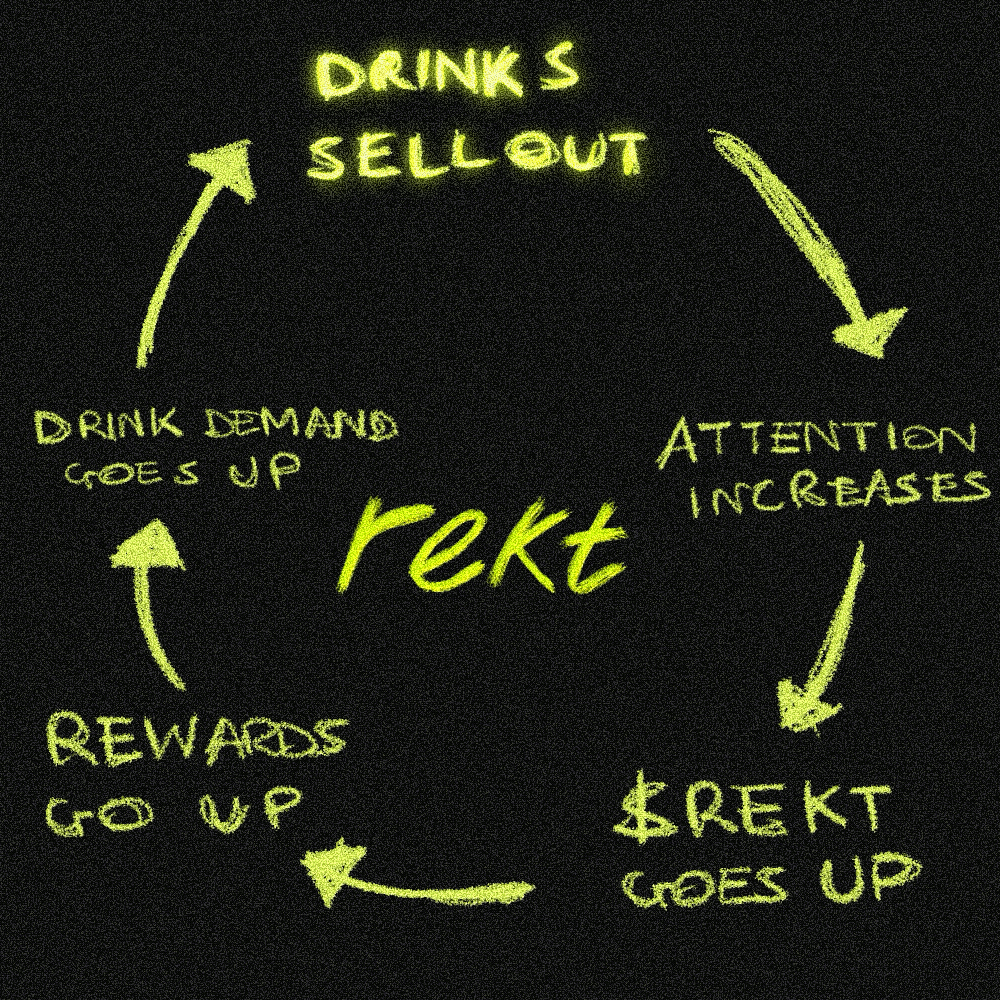
$REKT has already begun to demonstrate how belief, culture, product and price can form a self-reinforcing growth loop. We call this the $REKT flywheel. Here’s how it works:
1. Drinks sell out
Everything starts with demand for the physical product. For Rekt Drinks, that demand has been immediate and significant. The first drop of 222,000 cans sold out in under 48 hours, the second drop of 223,000 cans sold out in 40 minutes and the third drop of 180,000 cans sold out in just 17 minutes. This level of sell-through is virtually unheard of for an early-stage beverage brand and signals real-world traction beyond speculation.
2. Attention increases
Strong sales performance naturally attracts attention. It generates curiosity, commentary, and in some cases, scepticism. That is fine. In the attention economy, all attention is valuable. Each drink sell-out fuels media coverage, social discussion, and interest from both within and beyond the crypto space.
3. $REKT price rises
Token prices are often driven by attention. When the Rekt ecosystem gains visibility, interest flows into $REKT. This interest is reflected in the market. For example, $REKT rose by more than 600% in 2025 Q2 following multiple sell-outs. These movements are the product of narrative, belief, and network energy.
4. The reward pool grows
An initial total of 38.5% of the $REKT supply was reserved for future community rewards. As the token price increases, so does the value of this pool. At a fully diluted valuation of $150m, this equates to almost $60m. This pool functions as a form of marketing capital, but one that is held in token form rather than fiat. The larger it becomes, the more potential there is to engage, incentivise, and grow the REKT community.
5. Demand for drinks increases
A growing reward pool and rising token price create further demand for Rekt Drinks. As people realise that buying drinks could lead to $REKT rewards, interest builds. Although it might seem logical to buy at lower prices, the reality is that many people are drawn to momentum. When something is moving, it gets attention.
6. The cycle continues
Increased demand for drinks leads to more sell-outs. Sell-outs create more attention. Attention brings more activity. And so the flywheel spins.
3. Token Overview
3.1 Tokenomics and Distribution
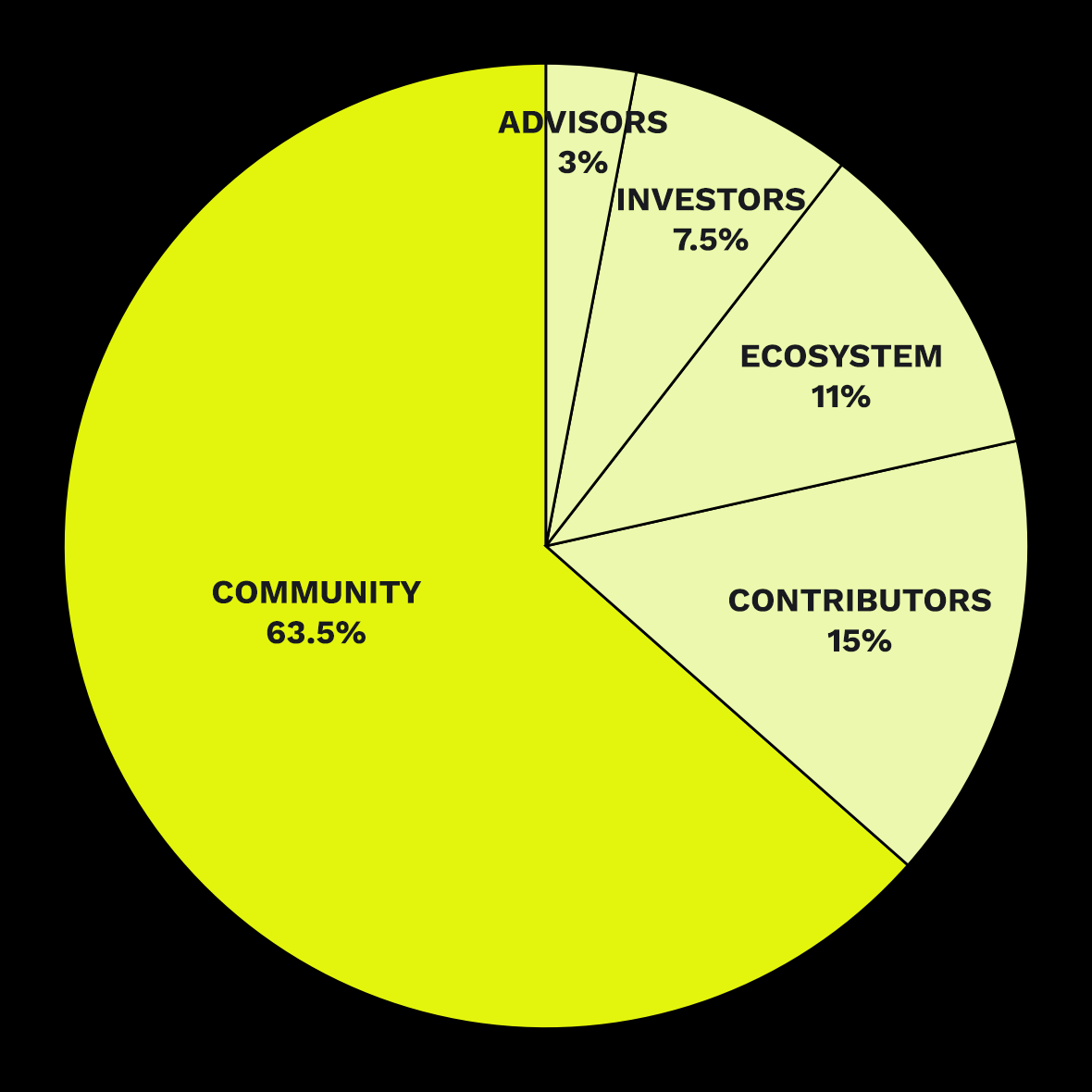
$REKT has a total supply of 420,690,000,000,000 tokens. The full supply was minted at launch and is permanently fixed. There is no inflation and no mechanism for future token issuance.
Tokens were initially distributed as follows:
- 63.5% Community
- Including 38.5% held back for future community rewards
- 15% Contributors
- 11% Ecosystem
- 7.5% Investors
- 3% Advisors
An initial airdrop was made to Rektguy NFT holders and buyers of the first Rekt Drinks product. Investors in Rekt Brands Inc, who participated in a $1.5m SAFE round, received an airdrop equal to 7.5% of the total supply. There was no SAFT or token warrant associated with the raise.
As of writing, 34% of the supply remains reserved for community rewards. This allocation will be distributed over time to support product incentives, activations, and other brand-aligned initiatives. There is no fixed vesting schedule, but deployment will be managed thoughtfully.
Rekt Brands Inc has also used a portion of its revenues to buy back $REKT tokens from the market. These buybacks are discretionary and reflect alignment between the brand and the token.
3.2 Trading and Infrastructure
$REKT was launched as an ERC20 on Ethereum mainnet and is tradable across multiple chains and venues. The token uses LayerZero's Omnichain Fungible Token (OFT) standard to enable cross-chain functionality, allowing users to bridge and interact with $REKT across supported ecosystems.
Primary Contract Addresses
Ethereum Mainnet: 0xdd3B11eF34cd511a2DA159034a05fcb94D806686
Bridged Contract Addresses
Base: 0xB3e3c89B8D9c88B1fe96856E382959eE6291ebbA
Abstract: 0x70f6e8d7771ee4c7d2fda6fbcc3eb8acbf533bca
Solana: vQoYWru2pbUdcVkUrRH74ktQDJgVjRcDvsoDbUzM5n9
Binance Smart Chain (BSC): 0x20482b0b4d9d8f60d3AB432b92F4c4B901a0D10C
Trading Access
$REKT is currently tradable on decentralised exchanges (DEXs) across Ethereum, Base, Abstract, Solana and BSC. Liquidity is pooled and user-driven
$REKT is also listed on multiple centralised exchanges (CEXs).
A comprehensive up-to-date list of trading pairs and markets can be found on CoinGecko or CoinMarketCap.
3.3 Legal Positioning
$REKT is a decentralised digital token intended as a memetic and cultural asset. It is not a security, does not represent equity or ownership, and does not entitle holders to revenue, dividends, or governance rights. It is not designed as a financial product, investment instrument, or utility token.
$REKT is not offered to the public in the European Union and is not admitted to trading on an EU-regulated crypto-asset platform. This document is not intended to serve as a crypto-asset whitepaper under Regulation (EU) 2023/1114 (MiCA).
The token was not issued by Rekt Brands Inc., and Rekt Brands Inc. does not hold any rights, control, or guarantees over the token. $REKT was issued by an independent Cayman Islands foundation named Golden Pothos Foundation, which exists separately from Rekt Brands Inc.
$REKT does not meet the definition of a security under the Howey Test, which is the primary legal framework used in the United States and referenced in other global jurisdictions. The Howey Test requires four criteria to be met:
- Investment of money
- In a common enterprise
- With an expectation of profit
- Derived from the efforts of others
While $REKT can be purchased with money, it does not constitute a common enterprise, does not promise any profit, and does not rely on the efforts of others to generate value. The token’s price is determined by market sentiment, cultural attention, and community activity, not by the business operations of any one entity.
$REKT is not an e-money token, is not asset-referenced, and is not intended to be used as a means of payment.
Trading or holding $REKT involves risk, including potential loss of value and extreme volatility. Users are responsible for their own decisions. No statements in this paper should be interpreted as financial, legal, or investment advice. This document is for informational purposes only.
The regulatory landscape around crypto assets is evolving. While $REKT does not meet the current definitions of a security under global standards, holders are encouraged to consult legal or tax professionals in their own jurisdictions.
4. Background and Timeline
Rektguy launch, Spring 2022
“Rektguy” is an NFT collection illustrated by digital artist and former high-yield credit trader Ovie Faruq (OSF), launched in collaboration with Michael Anderson (Mando), also a former high-yield trader. Initially created as a part-time artistic experiment by OSF in his evenings and weekends, the project was released with no roadmap or utility, purely as digital art. The free mint allowlist included holders of OSF’s previous artwork, their earlier (and failed) NFT project “Degenz”, and a public allocation. Within the first day of trading, the floor price reached approximately 0.5 ETH and peaked just below 2 ETH after Snoop Dogg acquired two pieces on the secondary market.
Bear market, 2022 to 2023
Global markets declined sharply and NFTs entered a prolonged downtrend. Despite the market conditions, the Rektguy community grew stronger. More people resonated with the idea of being “rekt”, finding comfort and camaraderie in the shared sentiment. All revenues generated were reinvested into the community, including physical events in London, Paris, and New York, all of which were consistently oversubscribed.
Cult growth and tattoos, Summer 2023
It became increasingly clear that Rektguy had achieved cult status. Unlike many collections that withered during the bear market, Rektguy’s community only deepened. The idea of being “rekt” had universal relatability and was often expressed with pride and humour, such as “I’m rekt, but I’m going to make it all back”. The community adopted the motto: “Down bad but never dead.” While many crypto projects claim to be cults, dozens of Rektguy holders literally inked their commitment, getting rekt tattoos, including OSF himself.
Rekt Brands Inc., Winter 2023
After months of discussion, the founders recognised that Rektguy had potential far beyond being an NFT collection. The “REKT” brand had IP value that could extend into real-world products. The team decided to launch Rekt Drinks, a flavoured sparkling water with low sugar, zero alcohol, and zero caffeine, aimed at making healthy drinking look cool. Although they had no experience in consumer goods, they saw drinks as a natural fit for the physical-heavy culture of Web3. Rekt Brands Inc. was incorporated as a Delaware C corp in December 2023.
Equity gifted to NFT holders, Spring 2024
Web3’s defining strength has been rewarding early supporters. But in NFTs, most projects returned value via airdrops, creating bloated ecosystems and weakening their collections through dilution. The founders saw this as a misalignment between community and operating teams. To address this, they offered equity in Rekt Brands Inc. to Rektguy holders, levelling the playing field between team, investors, and community. Equity was distributed in April 2024, using a snapshot from October 2023 to ensure no future expectation of profit. The offering was structured under the SEC Reg CF exemption and conducted via a registered broker-dealer with full KYC. While 10% of the company was made available, only around 5% was successfully claimed. REKT became one of the only crypto projects where community members hold real equity.
Drink-to-earn, Autumn 2024
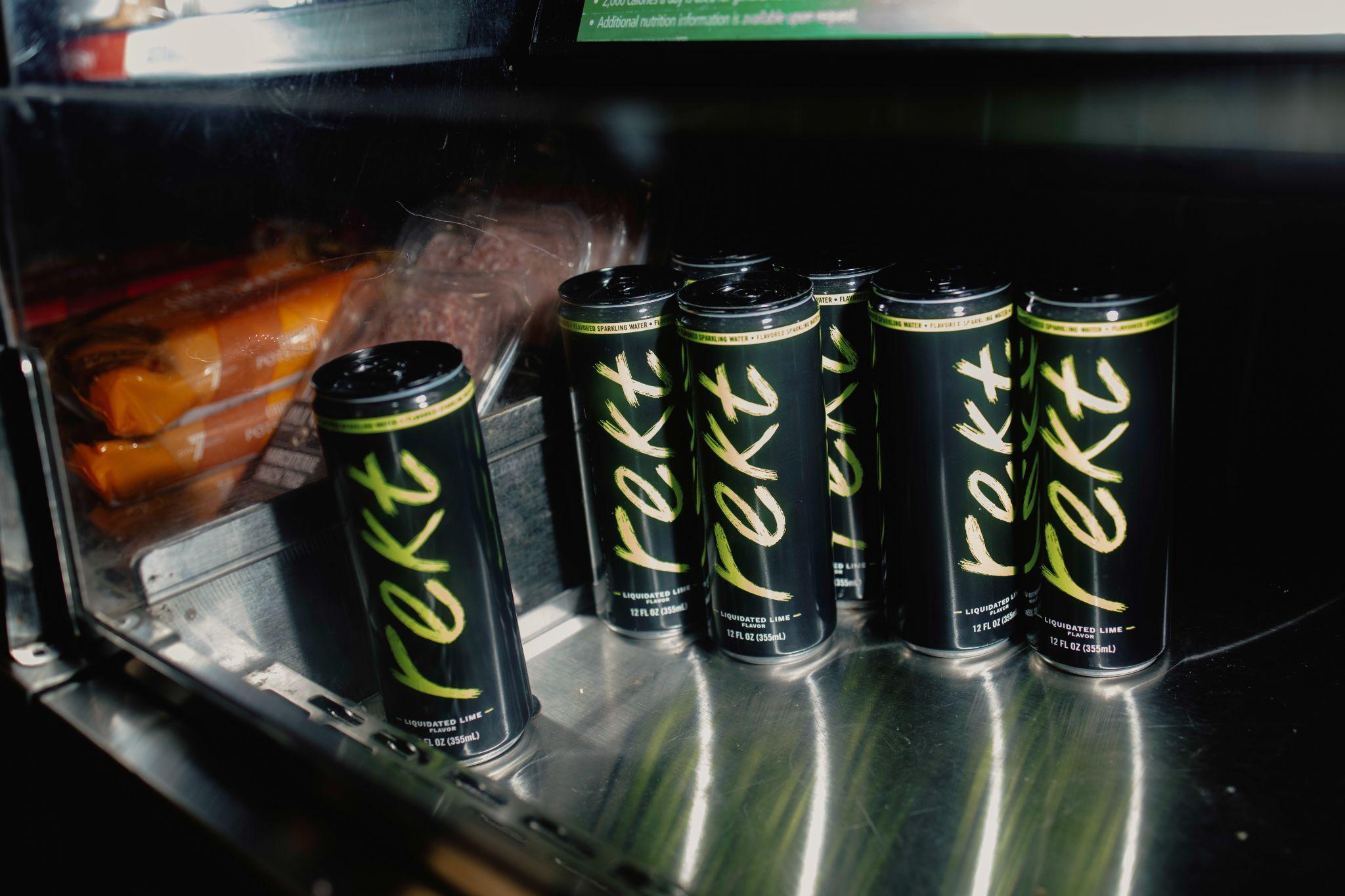
The first Rekt Drinks flavour, “Liquidated Lime”, launched after months of R&D. 250,000 cans were produced across the US and UK, with 222,456 made available globally. Buyers received “DRANK points” redeemable for $REKT, effectively earning crypto for buying real-world drinks. Unlike traditional token airdrops rewarding on-chain activity, REKT inverted the model by rewarding off-chain behaviour in a legacy industry. All drinks sold out in under 48 hours across 32 countries, marking a Web3-native disruption of the beverage space.
TGE and Capital Raise, Winter 2024
After the successful drinks launch, Rekt Brands Inc. raised $1.5m via a SAFE round in November 2024, from angels within the community. No SAFT or token warrants were issued, but 7.5% of the $REKT token supply was airdropped to investors. 63.5% of supply was allocated to the community, including an initial 24.5% airdrop to NFT holders and drink buyers. 39% was retained for future community rewards, with the remainder distributed to contributors (15%), ecosystem and partners (14%), investors (7.5%), and advisors (3%).
Collaborations and store launches, H1 2025
In 2025, Rekt Drinks expanded with three major collaborations:
Abstract Chain - 223,456 “Abstract Apple” cans sold out in 40 minutes, with purchasers earning Abstract XP and DRANK Points (which converted to $REKT)
OpenSea - 180,000 “Ship Rekt” cans sold out in 17 minutes, with purchasers earning Abstract XP, OpenSea XP and DRANK Points (which converted to $REKT)
Jupiter - 54,024 “Jupiter Drops” cans sold out in 20 minutes, with purchasers earning DRANK Points (which converted to $REKT)
This brought the total number of drinks sold by Rekt Brands Inc. to 679,936 within eight months. In June 2025, Rekt announced its first retail store presence across three 7-Eleven stores in Los Angeles, selling out 2,500 drinks within three days and taking the overall total to 682,436 drinks.